Beekeeping · 4 min read
How bee venom is collected without harming bees
A glass plate, a mesh of fine wires and a mild electrical impulse. The bee leaves a drop of venom, the stinger stays intact. This is how we do it at our apiary.
Author: Milan Protić · Published: 8 September 2026
Why the bee does not die
When a bee stings a mammal, its barbed stinger stays in the skin and the bee dies. During venom collection the stinger does not penetrate anything: the bee lands on a glass plate, feels a mild impulse, extends the stinger and releases a drop of venom onto the glass – then retracts the stinger and flies away. That is why this method is called collection without harming bees.
The device
The device has two parts:
- Impulse generator – produces direct or alternating pulsed current at a precisely set frequency.
- Applicator – a glass plate with a mesh of fine silver or stainless-steel wires stretched over it. It is placed at the hive entrance.
Bees landing on the mesh feel a mild impulse that contracts the muscles of the sting apparatus – and a drop of venom stays on the glass.
What happens next
- The venom is dried at about 40 °C and loses 70 % of its mass.
- It is scraped off the applicator as a fine powder, always wearing a mask and without draughts, because inhaling venom particles strains the liver.
- It is stored in a dark glass container filled to no more than a third; at room temperature it stays stable for up to 5 years.
The price the beekeeper pays
Bees are extremely aggressive during collection and stay irritable for several days. That is why we collect venom rarely, in small amounts and in a part of the apiary far from people. Those small amounts are also why our batches are small – and why we make them by hand.
Our apiary
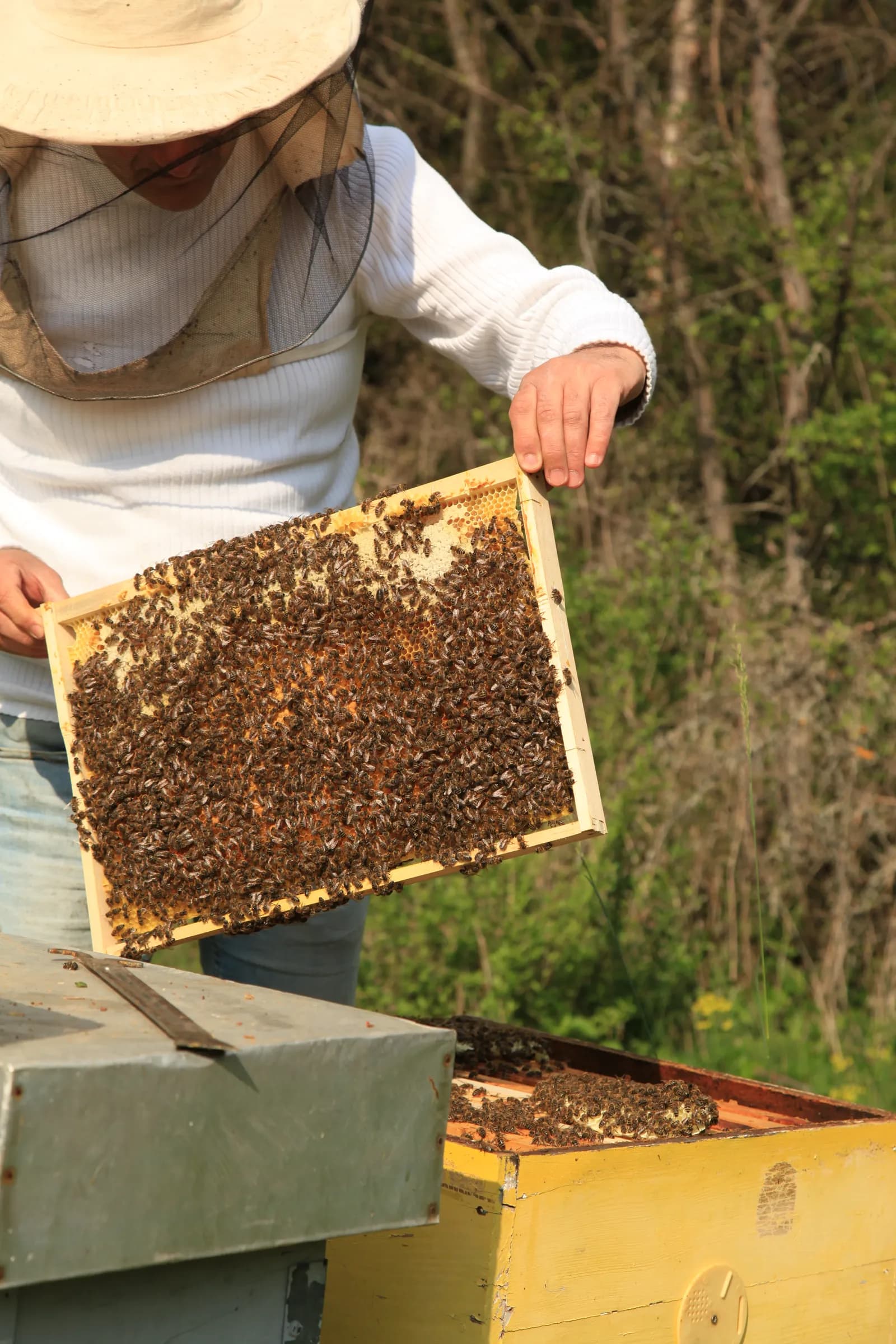
Our apiary is in Serbia, on terrain with diverse forage. The same beekeeper who tends the hives makes the skincare: the venom, beeswax, honey, bee bread and propolis in our products come from the same hives.